
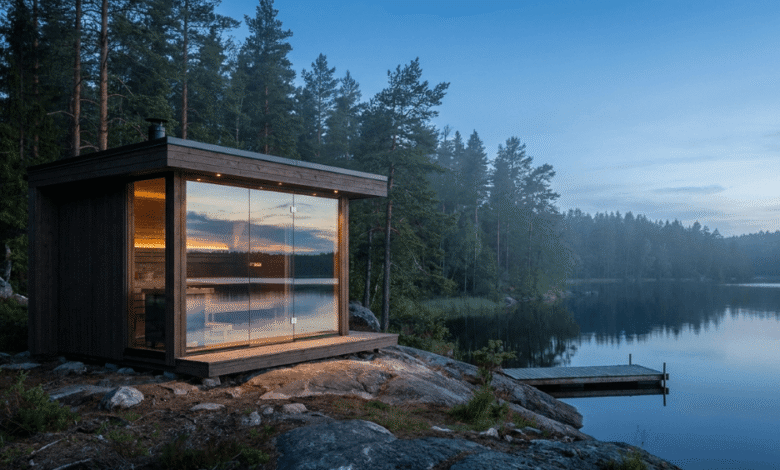
A budget outdoor sauna built for post-workout recovery should prioritize heater output matched to cubic footage, tight-fitting cedar or spruce construction, and a realistic electrical plan, ahead of any feature that only affects looks. Expect to spend $2,800 to $4,500 on a two-person unit with a heater, plus $400 to $1,200 for electrical work if your panel doesn’t already have capacity nearby. The goal is a cabin that reaches 170 to 190 degrees Fahrenheit reliably within about half an hour, not the largest box your yard can technically hold.
How Much Should a Recovery-Focused Outdoor Sauna Cost?
For someone using a sauna mainly to speed recovery after training, a compact two-person barrel or cabin is usually the right size and the right price. Entry-level cedar units start around $2,200 to $2,800, but that number often excludes the heater, which adds $600 to $1,400 depending on wattage and stone capacity. A realistic all-in budget for a unit that will see four or five sessions a week without falling apart inside two years lands closer to $3,500 to $5,000. Anything advertised well below that range usually cuts corners on wood thickness, insulation, or heater quality, all of which show up later as higher electric bills and a shorter heater life. Freight and delivery to a driveway typically add another $150 to $400 depending on distance from the manufacturer’s shipping hub, a cost buyers frequently forget to budget for until checkout.
What Heater Size Actually Matters for a Recovery Routine?
Heater sizing is measured in kilowatts against cubic footage, not square footage, and it is the single spec most likely to make or break a recovery routine. A well-sealed two-person cabin generally needs 4.5 to 6 kilowatts to reach 170 to 190 degrees within 30 to 40 minutes, which matters if you’re trying to fit a session in after a lift or a run before dinner. A heater sized too small for the cabin will still technically work, but it can take 60 minutes or longer to peak, runs continuously trying to hold temperature, and shortens its own working life in the process. Check the manufacturer’s cubic-footage chart against your actual cabin dimensions before ordering, not just the advertised kilowatt number on its own, and ask specifically how many pounds of stones the unit holds, since stone mass affects how evenly heat radiates once the cabin is up to temperature.
Does Sauna Frequency Change the Recovery Payoff?
The strongest evidence on sauna use and cardiovascular health comes from a long-running Finnish cohort, which found that men who used a sauna four to seven times a week had meaningfully lower rates of fatal cardiovascular events and all-cause mortality compared with men who used one once a week. A follow-up analysis looking at sauna bathing alongside cardiorespiratory fitness found the two factors were jointly associated with lower mortality risk, suggesting frequency and fitness both play a role rather than either one alone explaining the effect. A separate short-term study measured blood-based markers of cardiovascular function in regular sauna users and found favorable shifts after sessions. None of this proves that any single person’s recovery routine will produce the same outcome, since these are population-level associations rather than a guarantee tied to a specific training block. Still, the pattern across studies leans toward more frequent, moderate sessions rather than occasional long ones, which is worth keeping in mind when deciding how much heater capacity and how large a cabin actually makes sense.
Where Can You Cut Cost Without Cutting Comfort?
A few line items are safe to trim on a tight budget: bench upgrades, exterior staining, and premium door hardware rarely affect how the sauna performs. What isn’t safe to cut is heater wattage, wood thickness, and the vapor barrier behind the interior paneling, since all three affect how well the cabin holds heat over years of use, not just its first season. Before ordering, compare current listings and pricing across a few retailers, including specialty sellers such as Redwood Outdoors, Almost Heaven, and sweatdecks.com/collections/outdoor-saunas, since model-by-model pricing and heater specs vary enough between them to matter on a fixed budget. Buying the cheapest unit in a category is rarely the same as buying the best value once heater quality and expected lifespan are weighted against the sticker price.
What Maintenance Keeps a Budget Unit From Failing Early?
A budget sauna that gets daily or near-daily use for recovery needs more upkeep attention than one used occasionally. Wiping down benches after each session, leaving the door cracked to dry the interior between uses, and checking the heater’s stones every few months for mineral buildup all extend the life of a lower-cost unit meaningfully. Roof and door seals deserve a yearly check, since a gap that lets in moisture is what eventually warps panels and forces an early rebuild. None of this is expensive, but skipping it is the most common reason a budget sauna needs major repair inside three years instead of lasting a decade or more.
Is Buying Used or Off-Season a Real Way to Save?
Shopping the off-season, generally late winter into early spring before demand picks up, is one of the more reliable ways to knock 10 to 20 percent off a listed price without touching build quality. A used cabin can also work, but only if the heater elements still test as functional and the wood shows no soft spots, black staining, or panel separation at the seams, all signs of long-term moisture damage that no amount of cleaning fixes. Factor in the cost of a new heater and possibly new wiring before deciding a used unit is actually cheaper than a discounted new one, since those two line items alone can erase most of the apparent savings.
Frequently Asked Questions
How much does a budget outdoor sauna for recovery cost? A two-person cedar barrel or compact cabin built for regular use typically runs $2,800 to $4,500 for the unit and heater, before delivery and any electrical work. Add another $400 to $1,200 if a dedicated circuit is needed nearby.
How often should you use a sauna for recovery benefits? Research on regular sauna users points to sessions four or more times a week as the pattern most consistently associated with better cardiovascular outcomes, though two to three sessions a week is a reasonable starting cadence.
What heater size is enough for a recovery sauna? For a tight, well-insulated two-person cabin, 4.5 to 6 kilowatts is usually enough to reach 170 to 190 degrees Fahrenheit within 30 to 40 minutes.
Can you save money by buying a smaller heater? Undersizing the heater is one of the most common ways buyers overspend later. A heater that never reaches target temperature runs constantly and wears out faster than a correctly sized unit.
Is a used outdoor sauna a reasonable way to save money? It can be, if the heater still carries working elements and the wood shows no soft or delaminated panels. A used cabin with a failing heater is rarely a bargain once replacement wiring and a new heater are added to the price.
References
- Association between sauna bathing and fatal cardiovascular and all-cause mortality events, JAMA Internal Medicine, 2015
- Joint associations of sauna bathing and cardiorespiratory fitness on cardiovascular and all-cause mortality risk: a long-term prospective cohort study, Annals of Medicine, 2018
- Short-term effects of Finnish sauna bathing on blood-based markers of cardiovascular function in non-naive sauna users, Heart and Vessels, 2018

